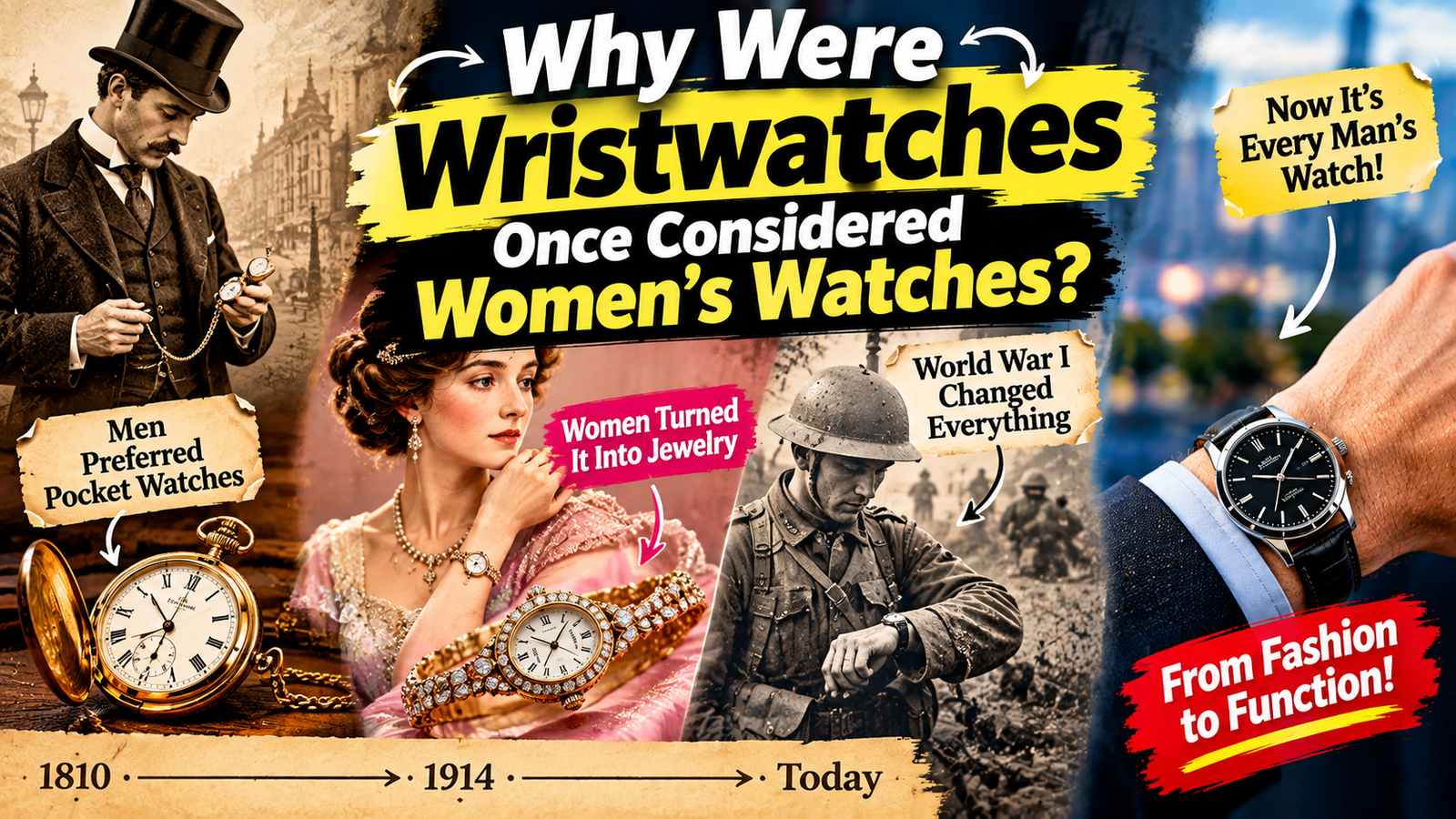
Imagine telling someone 150 years ago that almost every man would one day wear a watch strapped around his wrist.
They might have found the idea strange.
For much of the 19th century, a respectable man was far more likely to carry a pocket watch than wear a watch on his wrist. Wristwatches, meanwhile, were increasingly associated with women, fashion, and jewelry.
So how did something that was once seen as feminine become one of the most common accessories for men?
The answer involves fashion, technology, and, surprisingly, World War I.
Men Preferred Pocket Watches
During the 19th century, the pocket watch was the traditional men’s timepiece.
A gentleman could keep a watch inside his waistcoat or coat pocket and pull it out whenever he needed to check the time.
It wasn’t just practical. It was part of the way a well-dressed man was expected to look.
A watch worn openly on the wrist was a very different proposition.
For many people at the time, a small watch attached to the wrist looked more like jewelry than a serious instrument. That made it much easier for wristwatches to become associated with women’s fashion.
You may also like this article :- Why Did Cars Get Speedometers? The Surprising History of Speed Limits
Women Turned Watches Into Jewelry
Watchmakers soon discovered that a tiny watch could be combined with something women were already accustomed to wearing: bracelets.
Instead of simply making a watch smaller, manufacturers could decorate it with precious metals, gemstones, elaborate cases, and decorative bracelets.
The result was something that did two jobs at once.
It told the time.
And it looked like jewelry.
Historical sources describe early wristwatches as delicate watches worn by women as part of their jewelry, reinforcing the idea that wrist-worn timepieces were a feminine fashion.
But there’s an even more fascinating example.
You may also like this article :- Why Does a Cricket Wicket Have Three Stumps?
The Queen Who Ordered a Wristwatch in 1810
One of the earliest—and best-documented—wristwatches dates back to 1810.
Caroline Murat, Queen of Naples and Napoleon Bonaparte’s younger sister, commissioned the famous French watchmaker Abraham-Louis Breguet to create a watch specifically designed to be worn on the wrist.
Breguet’s surviving records document the commission dated June 8, 1810.
The watch was exceptionally thin, oval-shaped, and mounted on a wristlet made with hair intertwined with gold thread. It was also a repeating watch, meaning it could audibly indicate the time.
So the wristwatch wasn’t invented during World War I.
It was already around more than a century earlier.
The problem was that it hadn’t yet become the normal men’s watch.
You may also like this article :- Why Are Phone and Calculator Keypads Reversed?
Why Didn't Men Just Wear Them?
Because fashion can be surprisingly powerful.
A man in Victorian or Edwardian society wasn’t necessarily forbidden from wearing a wristwatch. But the cultural meaning of an object mattered.
Pocket watches were associated with men’s clothing and professional life.
Wristwatches were increasingly associated with women’s fashion.
And when something becomes part of a particular style, people tend to follow the social expectation—even when the alternative might actually be more convenient.
That meant the wristwatch needed something more powerful than fashion to change its image.
It needed a reason for men to need it.
Then came war.
World War I Changed Everything
On a battlefield, reaching into your pocket to retrieve a watch isn’t always convenient.
And sometimes, knowing the exact time isn’t just convenient.
It’s critical.
Military operations required precise coordination. Officers needed to synchronize movements, coordinate attacks, and time artillery fire.
During World War I, wristwatches became particularly useful because soldiers could check the time quickly without having to dig around for a pocket watch.
Smithsonian’s historical account notes that officers used wristwatches to coordinate carefully timed attacks, where fumbling for a pocket watch could be impractical.
Suddenly, the wrist wasn’t a strange place to put a watch.
It was an excellent place.
You may also like this article :- How 16:9 Became the Standard TV Screen Size
Soldiers Helped Make Wristwatches Masculine
This is where the cultural shift became powerful.
Men who returned from the war were wearing wristwatches.
And these weren’t men wearing delicate jewelry because it was fashionable.
They were soldiers who had used wristwatches as practical tools.
That changed the perception.
If a soldier could wear a watch on his wrist, then the wristwatch clearly wasn’t just a women’s accessory.
The old association between wristwatches and femininity gradually weakened.
From Fashion Accessory to Everyday Tool
After the war, the wristwatch continued to grow in popularity among men.
Watchmakers also adapted.
Men’s watches became larger, sturdier, and more focused on practicality. Designs increasingly emphasized durability and readability rather than the delicate jewelry-like appearance associated with earlier women’s wristwatches.
The wristwatch had effectively changed categories.
It wasn’t simply jewelry anymore.
It was a tool you wore.
And that distinction mattered.
So, Was the Wristwatch Ever Really "Gender Neutral"?
Not at first.
For a significant part of its early history, wristwatches were strongly associated with women’s fashion, while pocket watches were culturally associated with men.
But the technology itself was never inherently masculine or feminine.
The same basic idea—a small clock attached to your wrist—could serve completely different cultural purposes depending on who wore it and why.
World War I helped demonstrate its practical value to men on a massive scale.
And once that happened, the old stereotype became much harder to maintain.
The Wristwatch We Know Today
Look at a modern watch store and you’ll find watches marketed to men, women, and everyone in between.
Some are luxury pieces.
Some are sports watches.
Some are smartwatches.
Some are almost entirely about fashion.
But the basic idea remains remarkably simple:
Put a timepiece where you can see it instantly.
Ironically, that’s exactly what made the wristwatch so useful in the first place.
The wrist wasn’t a feminine place for a watch.
It was simply a convenient one.
It just took changing fashion—and a world war—for society to realize it.
You may also like this article :- Why Aren’t AI Data Centers Built in Antarctica?
Key Takeaways
- In the 19th century, men generally favored pocket watches, while wristwatches became associated with women’s fashion and jewelry.
- Women’s wristwatches were often designed as decorative accessories or bracelet watches.
- Caroline Murat, Queen of Naples, commissioned a wristwatch from Breguet in 1810, providing one of the earliest well-documented examples.
- Wristwatches already existed before World War I; the war helped make them practical and socially acceptable for men.
- Soldiers and military officers valued wristwatches because they could check the time quickly during coordinated operations.
- After World War I, the wristwatch gradually became a mainstream, gender-neutral accessory.
FAQs
1. Were wristwatches originally made for women?
Many early wristwatches were marketed toward women and incorporated into jewelry and fashion. However, wrist-worn watches were not exclusively for women.
2. When did men start wearing wristwatches?
Men wore wristwatches before World War I, but their use became much more widespread among men during and after the war because of their practical military advantages.
3. Who had the first wristwatch?
One of the earliest well-documented wristwatches was commissioned by Caroline Murat, Queen of Naples, from Abraham-Louis Breguet in 1810. Breguet’s archives identify the watch as number 2639.
4. Why did soldiers wear wristwatches?
Wristwatches allowed soldiers and officers to check the time quickly without reaching into a pocket. Precise timing was important for military coordination and attacks.
5. Did World War I invent the wristwatch?
No. Wristwatches existed long before World War I. The war helped transform their image and greatly increased their practical appeal among men.
6. Why were pocket watches popular with men?
Pocket watches fit naturally into the formal clothing worn by men during the 19th century and were considered an appropriate and practical men’s accessory.
Pingback: Why Were Chandeliers a Symbol of Wealth and Royalty?
Pingback: Why Are Donkeys Considered Dumb When They’re Actually So Clever?