Have you ever noticed something strangely annoying about numbers?
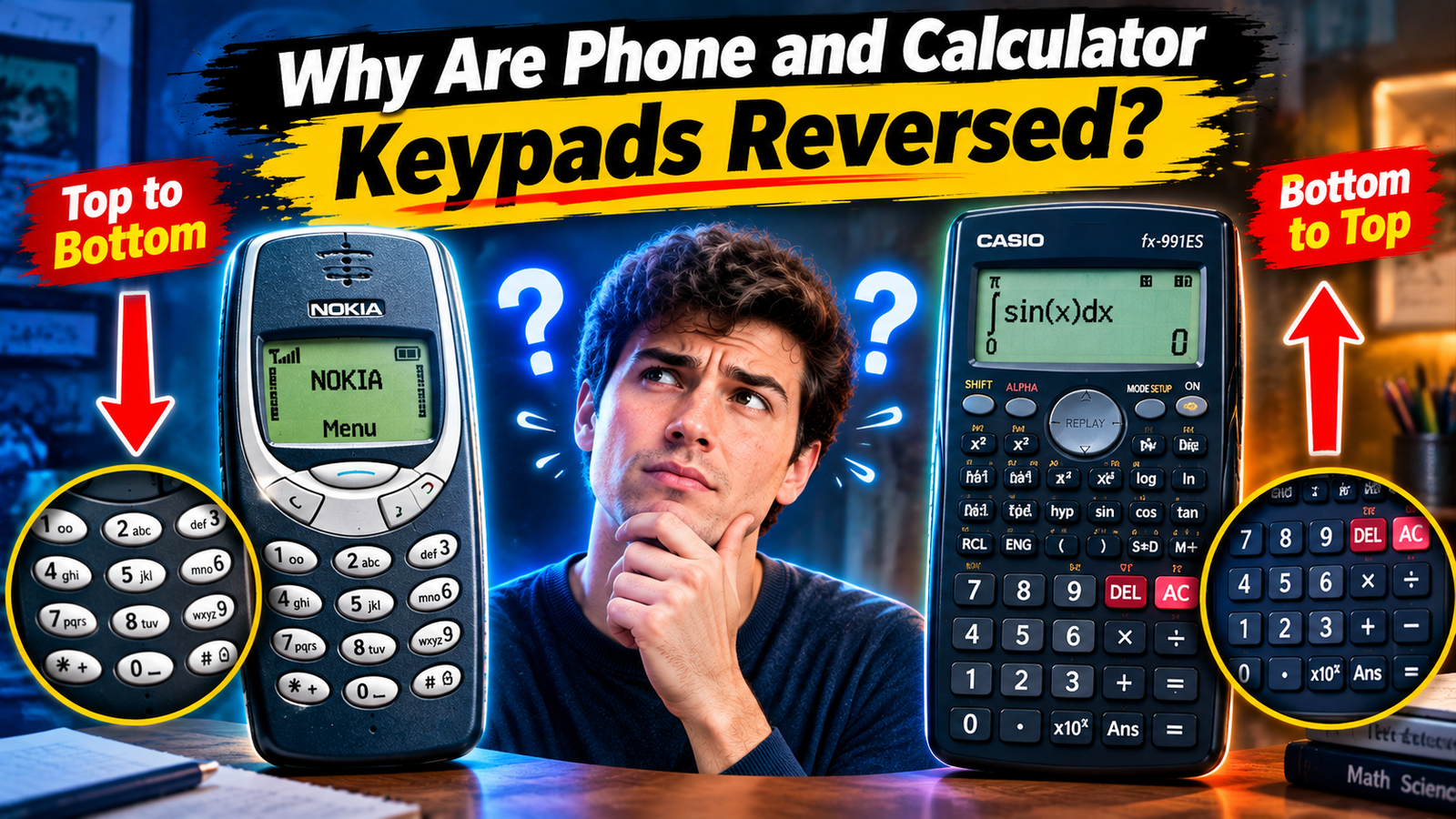
Look at your calculator and you’ll see 7, 8, 9 at the top, followed by 4, 5, 6, and then 1, 2, 3 at the bottom.
Now open your phone.
Suddenly, everything is flipped.
Your phone starts with 1, 2, 3 at the top, then 4, 5, 6, and finally 7, 8, 9 at the bottom.
It seems like someone simply decided to make our lives more confusing.
But this isn’t an accident. The two layouts came from two very different design histories—and one of them was shaped by surprisingly careful human research.
Why Do Calculators Have 7, 8, 9 at the Top?
To understand the calculator layout, we need to go back before electronic calculators existed.
Early adding machines and other mechanical calculating devices used number arrangements that eventually influenced the familiar calculator keypad. As these machines became important tools for accountants, bookkeepers, cashiers, and other professionals, their key layouts became familiar through everyday use.
The important point is that the calculator layout wasn’t created specifically for today’s handheld calculator. It was inherited from earlier adding-machine designs.
By the middle of the 20th century, the arrangement with the lower numbers toward the bottom had become increasingly familiar in numerical data-entry machines. When electronic calculators arrived, there was little reason to completely retrain people who already knew how to use these keypads.
So the old arrangement survived.
And it survived for a very long time.
That’s also why the same basic layout eventually appeared on computer numeric keypads.
But Why Didn't Phones Copy the Calculator?
This is where the story gets much more interesting.
When telephone companies began developing push-button telephones, they weren’t simply replacing a calculator keypad.
They were replacing something completely different: the rotary dial.
Bell Telephone Laboratories was working on a push-button system that could make dialing faster and easier than rotating a traditional telephone dial. But engineers faced a basic question:
Where should the numbers go?
Should they copy the calculator?
Should they arrange the numbers in a circle like a rotary dial?
Or should they try something completely new?
Instead of guessing, researchers tested people.
Bell Labs Asked 300 People Where Numbers Should Go
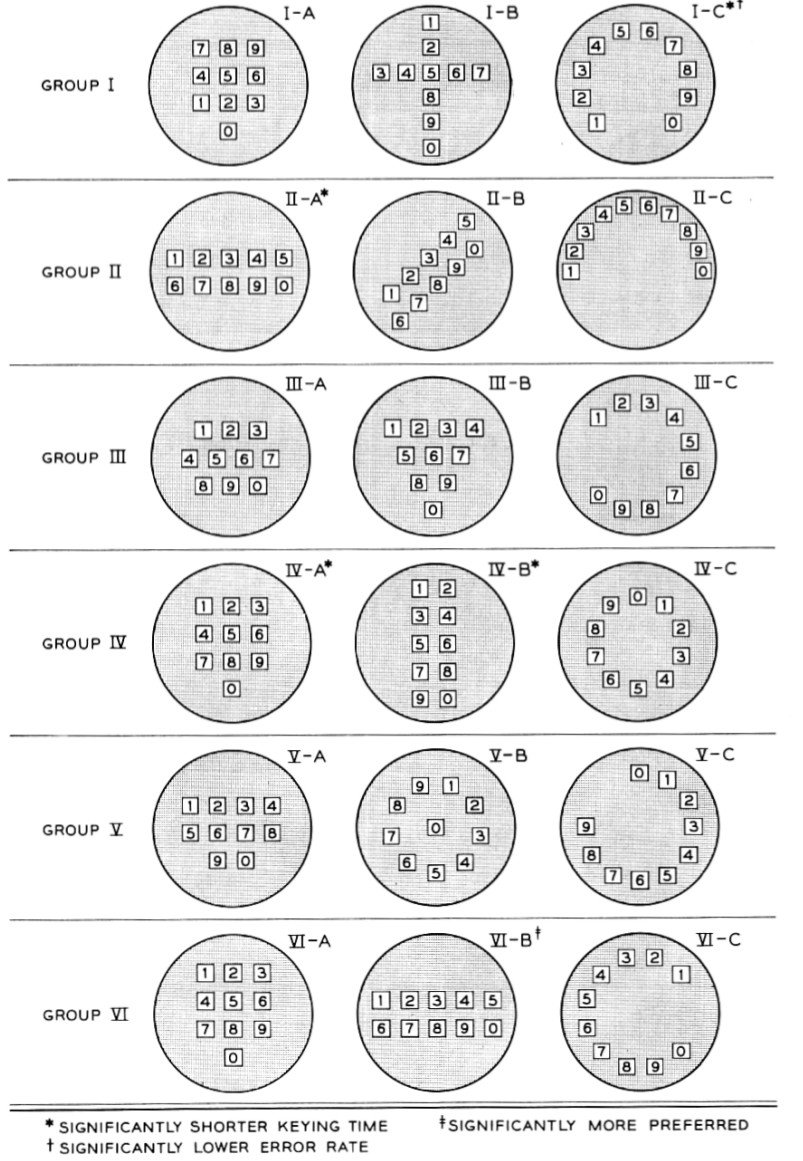
In 1955, Bell Labs researchers Mary C. Lutz and psychologist Alphonse Chapanis conducted a study involving 300 people.
The participants were shown different blank key arrangements and asked to place numbers and letters where they expected them to belong.
The researchers tested six different configurations.
And the result was surprisingly clear.
People overwhelmingly preferred layouts in which the numbers increased from left to right and from top to bottom. In other words:
1 2 3
4 5 6
7 8 9
That is almost exactly the layout you’ve been using on phones for decades.
The research suggested that this arrangement felt natural to people because it matched the way they were accustomed to organizing and reading information.
The 3×3 Layout Wasn't the Only Design Considered
Bell Labs didn’t simply compare a phone keypad with a calculator.
Researchers considered several different arrangements, including circular, diagonal, horizontal, and other rectangular configurations.
The goal wasn’t just to find a layout that looked good.
They wanted to know which arrangement people could use accurately and comfortably.
Later work by Bell Labs engineer R. L. Deininger examined key arrangement along with other factors such as button design, force required to press the keys, and how people actually entered telephone numbers. The research found that user preference and performance both mattered when choosing the final design.
And eventually, the familiar 1-2-3 at the top arrangement won.
What About the Story That Phones Were Designed to Slow People Down?
Here’s where things get a little controversial.
You may have heard a popular explanation that accountants and professional calculator users were so fast at entering numbers that telephone engineers deliberately reversed the calculator layout.
The idea was simple: if people were forced to use an unfamiliar arrangement, they would type more slowly, giving the telephone system enough time to recognize every input.
It sounds believable.
But there’s a problem.
Historical accounts and Bell Labs research don’t provide strong evidence that this was the main reason for reversing the layout. The theory has been repeated for years, but even sources discussing the history warn that it shouldn’t be treated as the definitive explanation.
The stronger explanation is much simpler:
Bell Labs tested different layouts and found that people generally preferred the top-to-bottom numerical arrangement.
So Which Layout Is Actually Better?
That depends on what you’re doing.
A calculator is primarily a data-entry tool. Its layout developed from machines designed for people who entered numbers repeatedly and quickly.
A telephone, on the other hand, was designed for the general public. Bell Labs wanted a layout that ordinary users could understand and operate easily.
So both layouts make sense within their original context.
The funny part is that today we use both constantly.
You might enter a number on your phone with 1 at the top, then move to your computer and suddenly find 1 at the bottom.
Your brain has simply learned to switch between them.
You may also like this post :- Why Aren’t AI Data Centers Built in Antarctica?
Why Haven't We Standardized Them All?
By now, you might wonder why someone hasn’t just decided to make every keypad identical.
The answer is history and muscle memory.
Millions of people have spent decades using calculator-style numeric keypads, while billions have become accustomed to telephone-style keypads.
Changing either one would create a huge amount of unnecessary confusion.
So the strange difference has become a feature of everyday technology.
And that’s the fascinating lesson here: sometimes a design survives not because it’s perfect, but because people have already learned it.
The Next Time You See a Keypad...
Take a second to look at it.
Your calculator’s 7-8-9 at the top is part of the legacy of mechanical calculating machines.
Your phone’s 1-2-3 at the top came from a very different path—one influenced by Bell Labs’ human-factors research and testing with real users.
So no, someone didn’t randomly turn the numbers upside down.
Two different technologies simply asked two different questions.
And they came up with two different answers.
You may also like this post :- How 16:9 Became the Standard TV Screen Size
Key Takeaways
- Calculators inherited their number arrangement from earlier mechanical adding machines and numerical data-entry machines.
- Telephone keypads were developed separately as push-button systems replaced rotary dialing.
- Bell Labs conducted human-factors research to determine which keypad arrangement people preferred.
- A 1955 study tested 300 participants and found strong preference for numbers increasing from left to right and top to bottom.
- The popular “phones reversed calculators to slow down fast accountants” story is not firmly established as the historical reason.
- The two layouts survived because users became familiar with them and because they serve different types of tasks.
FAQs
1. Why are phone numbers arranged differently from calculators?
Phone keypads were designed independently from calculator and adding-machine keypads. Bell Labs research found that people preferred the 1-2-3 arrangement at the top.
2. Why do calculators have 7, 8, 9 at the top?
The layout developed from earlier mechanical adding machines and became established for numerical data entry before electronic calculators became common.
3. Did Bell Labs test different telephone keypad layouts?
Yes. Researchers tested several arrangements, including different grid and non-grid configurations, before settling on the familiar telephone layout.
4. Did Bell Labs reverse the keypad to slow down accountants?
That’s a popular theory, but it isn’t well established as the actual reason. The documented research strongly supports human preference and usability as important factors.
5. Why is 1 at the top of a phone keypad?
Bell Labs’ research found that users strongly preferred arrangements where numbers increased from left to right and from top to bottom.
6. Why do computer number pads look like calculators?
Computer numeric keypads inherited the established calculator and adding-machine arrangement, with 7-8-9 at the top and 1-2-3 at the bottom.
Pingback: Why Did Cars Get Speedometers? The History of Speed Limits