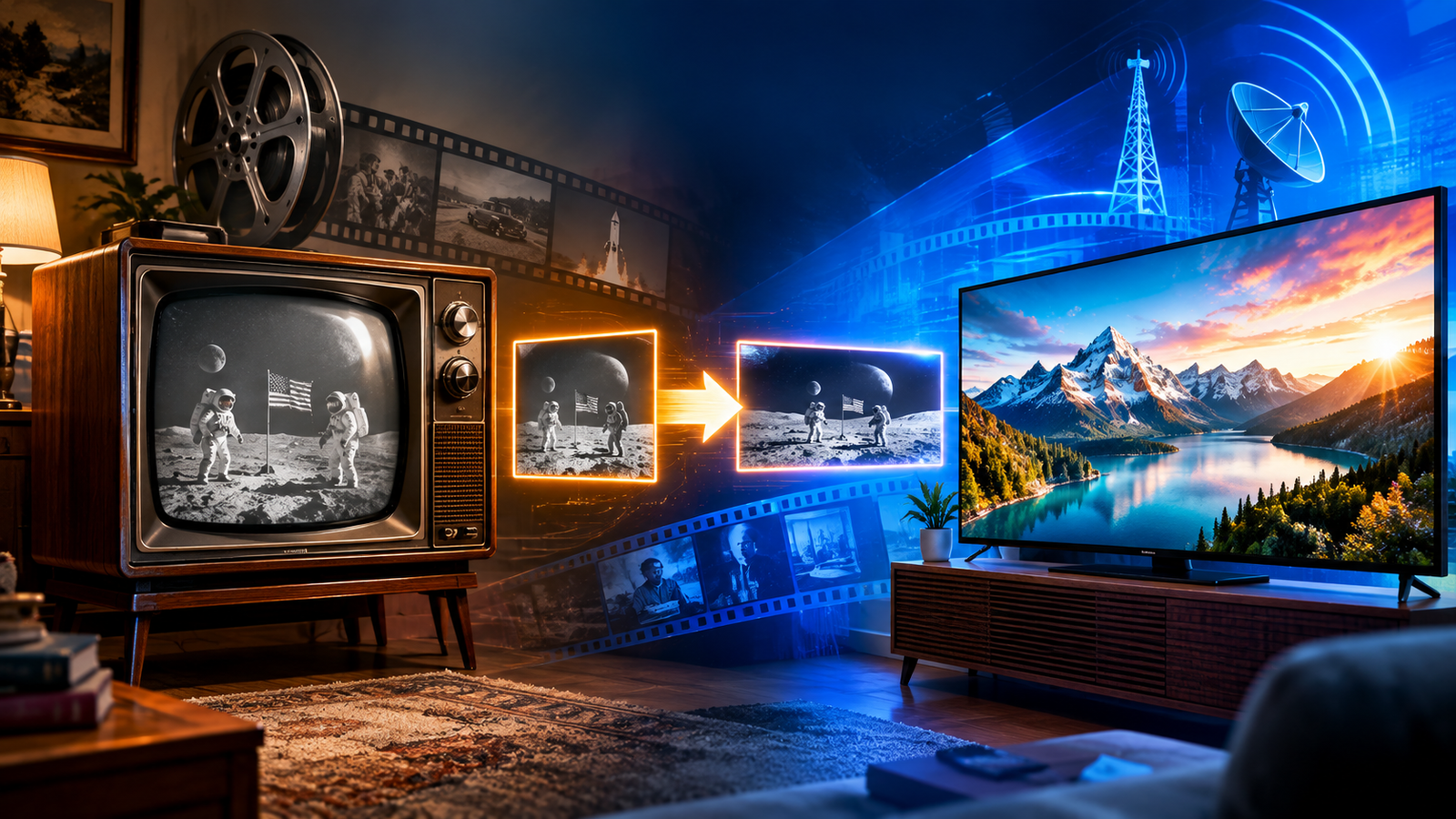
Why Were Old TVs Almost Square?
Take a look at the old televisions of yesteryear and compare them with the modern screen you are likely viewing right now.
There is a distinct difference between the two.
Old-fashioned TVs were typically square, featuring a 4:3 aspect ratio. In contrast, contemporary televisions, laptops, YouTube videos, and most digital content utilize the much wider 16:9 format.
But why exactly did this shift in television screens occur?
And an even more important question is: why did engineers prioritize 16:9 over other ratios like 15:9, 18:9, or 2:1?
The answer to this puzzle takes us back to a time when Hollywood was struggling to entertain audiences and television was emerging as its biggest competitor.
Why Did Early TVs Use 4:3?
The 4:3 shape wasn’t originally created for modern television. Early television inherited a format that was already common in motion pictures.
Early film formats were relatively close to a 4:3 shape, and television eventually adopted the same basic proportion. By the middle of the 20th century, 4:3 had become the standard television format.
It made sense at the time.
But then something happened that changed the entertainment industry.
Television became incredibly popular.
Suddenly, people could watch entertainment from their living rooms without buying a movie ticket.
And Hollywood wasn’t particularly happy about that.
Hollywood Had a Problem: Why Leave Home?
Imagine you’re sitting comfortably at home with your new television.
Why would you spend money, travel to a theater, and sit in a dark room for two hours?
Hollywood needed an answer.
The solution was simple:
Give audiences something their television couldn’t reproduce.
Movies became bigger, wider, and more spectacular.
This led to the development and popularity of widescreen formats such as Cinerama, CinemaScope, and VistaVision. Cinerama, for example, debuted in 1952 using three synchronized 35mm film strips projected onto a huge curved screen. CinemaScope followed in 1953 with a different approach that used anamorphic lenses to create a much wider picture from 35mm film.
The battle between television and cinema had effectively changed the shape of movies.
But television itself was still stuck with 4:3.
And eventually, that created another problem.
Television Needed a New Shape
By the 1980s, television technology was moving toward high-definition systems.
There was just one awkward problem.
Movies were being made in many different shapes.
Some were relatively close to 4:3. Others used wider formats such as 1.85:1 or 2.35:1 and beyond.
If television was going to move to a new high-definition format, engineers needed to choose one standard shape that could work reasonably well with all of them.
They didn’t want a screen that was so wide that older material became awkward to display.
But they also didn’t want a screen that was so narrow that widescreen movies required huge amounts of cropping.
So engineers went looking for a compromise.
That’s where Kerns Powers entered the story.
The Surprisingly Clever Math Behind 16:9
In 1984, Kerns H. Powers was working with the SMPTE Working Group on High-Definition Electronic Production.
Instead of simply guessing what the perfect screen shape should look like, Powers compared the major aspect ratios being used at the time.
He represented the different formats as rectangles and normalized them to have equal areas.
Then he overlaid those rectangles around the same center point.
And something interesting happened.
The different formats could be accommodated reasonably well by a rectangle with an aspect ratio of approximately 1.77:1.
That was remarkably close to 16:9, which equals approximately 1.78:1.
In other words, 16:9 wasn’t pulled out of a hat.
It was a carefully calculated compromise.
Why Was 16:9 Such a Good Compromise?
Think of it as finding the sweet spot between two extremes.
On one side, you had traditional 4:3 television.
On the other, you had much wider cinematic formats.
A 16:9 screen was wide enough to provide a more cinematic viewing experience, while still being close enough to older and narrower formats that content could be adapted without completely destroying the image.
The idea also supported what’s sometimes called a “shoot and protect” approach: filmmakers could compose important action inside a central area so that the same material could later be adapted to different aspect ratios.
That’s a pretty clever solution to a surprisingly complicated problem.
So, Who Decided That 16:9 Should Become the Standard?
The SMPTE high-definition working group accepted the approximately 1.77:1 result and rounded it to 16:9.
The ratio was later reaffirmed during work associated with the Advanced Television Systems Committee, helping establish it as the standard for HDTV.
And once HDTV adopted 16:9, the format spread rapidly.
Today, that shape is everywhere.
Your television.
Your computer monitor.
YouTube videos.
Streaming platforms.
Digital cameras.
And, of course, the 1280×720 and 1920×1080 video formats that many of us use without ever thinking about the mathematics behind them.
The Funny Part: 16:9 Wasn't Really Designed Just for TVs
Here’s the part I find most interesting.
The original problem wasn’t simply:
“What shape should the next television be?”
The bigger challenge involved the transition toward electronic production of movies and the fact that the film industry was already using many different aspect ratios.
A single electronic production format needed to accommodate that messy world.
Kerns Powers’ solution provided a practical way to bridge those formats.
And eventually, that solution became the shape of the screen sitting in your living room.
Final Thoughts
So, how did 16:9 become the standard TV aspect ratio?
It wasn’t because someone decided that wider screens simply looked better.
It was the result of decades of technological change, competition between Hollywood and television, the arrival of HDTV, and some surprisingly elegant mathematics.
Television started with the relatively square 4:3 format. Cinema then became dramatically wider as Hollywood looked for ways to offer audiences something they couldn’t experience at home.
When high-definition television arrived, engineers needed a format that could live somewhere between the old television world and the much wider world of cinema.
Kerns Powers’ analysis produced approximately 1.77:1.
Round that to 16:9, and you get the screen shape that eventually became the modern video standard.
So the next time you watch a movie or YouTube video on a widescreen display, remember: that rectangle on your screen is the result of a surprisingly long battle between cinema, television, technology—and mathematics.
You may also like this post :- How Does Heat Escape in Space? The Science Behind Space Cooling Explained
Key Takeaways
- Early television commonly used a 4:3 aspect ratio.
- Hollywood adopted wider formats partly to make the cinema experience different from watching TV at home.
- Cinerama, CinemaScope, and VistaVision helped popularize widescreen cinema.
- HDTV needed a single format capable of working with many existing film and television aspect ratios.
- Kerns H. Powers studied the major formats and found approximately 1.77:1 as a useful compromise.
- 16:9 equals approximately 1.78:1, making it extremely close to Powers’ calculated value.
- 16:9 eventually became the dominant aspect ratio for HDTV and modern digital video.
FAQs
1. Why were old TVs 4:3?
Early television adopted a picture shape close to the film and display standards already in use, making 4:3 the established television format for decades.
2. Why did movies become widescreen?
Hollywood wanted to offer audiences a larger and more immersive experience that was difficult to reproduce on increasingly popular home televisions.
3. Who invented the 16:9 aspect ratio?
Kerns H. Powers proposed the approximately 1.77:1 format in 1984 while working with the SMPTE High-Definition Electronic Production group. The value was subsequently rounded to 16:9.
4. Why is 16:9 exactly 1.78:1?
Because 16 divided by 9 equals approximately 1.7778, which is normally rounded to 1.78:1.
5. Is 16:9 the same as widescreen?
In modern television and digital video, 16:9 is commonly described as widescreen. However, many movies use even wider formats, such as 1.85:1 or around 2.39:1.
Pingback: Why Are Phone and Calculator Keypads Reversed?
Pingback: Why Did Cars Get Speedometers? The History of Speed Limits