If Space Is So Cold, Why Can't Everything Cool Down Instantly?
Imagine someone tells you, “Let’s build AI data centers in space. It’s freezing cold up there, so cooling won’t be a problem.”
It sounds logical.
After all, outer space is incredibly cold. But here’s the surprising truth: keeping electronics cool in space is actually much harder than many people think.
The reason is simple—cold temperature alone doesn’t remove heat.
On Earth, heat escapes in several ways. In space, almost all of those methods disappear.
So, where does the heat actually go?
Let’s break it down in simple language.
How Heat Normally Travels on Earth
Before understanding space, let’s first see how heat moves around us every day.
There are three main ways heat is transferred:
1. Conduction
Conduction happens when two objects touch each other.
For example, place a metal spoon in a cup of hot tea. After a few minutes, the handle becomes hot even though it never touched the tea directly.
The heat simply travels through the metal.
2. Convection
This is the method we experience most often.
When you’re sweating on a hot day, moving air carries heat away from your skin. That’s why a fan makes you feel cooler even though it doesn’t actually lower the room’s temperature.
Similarly, a refrigerator removes heat from inside the compartment and releases it into the surrounding air through the condenser coils at the back.
Convection only works because air (or another fluid) is present to carry heat away.
3. Radiation
Radiation is completely different.
Instead of requiring air or physical contact, heat is transferred as electromagnetic waves, mostly in the infrared part of the spectrum.
In fact, this is exactly how sunlight warms the Earth across the vacuum of space.
What Changes in Outer Space?
Here’s the biggest difference.
Space is almost a perfect vacuum.
That means:
- There is virtually no air for convection.
- There is usually nothing touching a spacecraft for conduction.
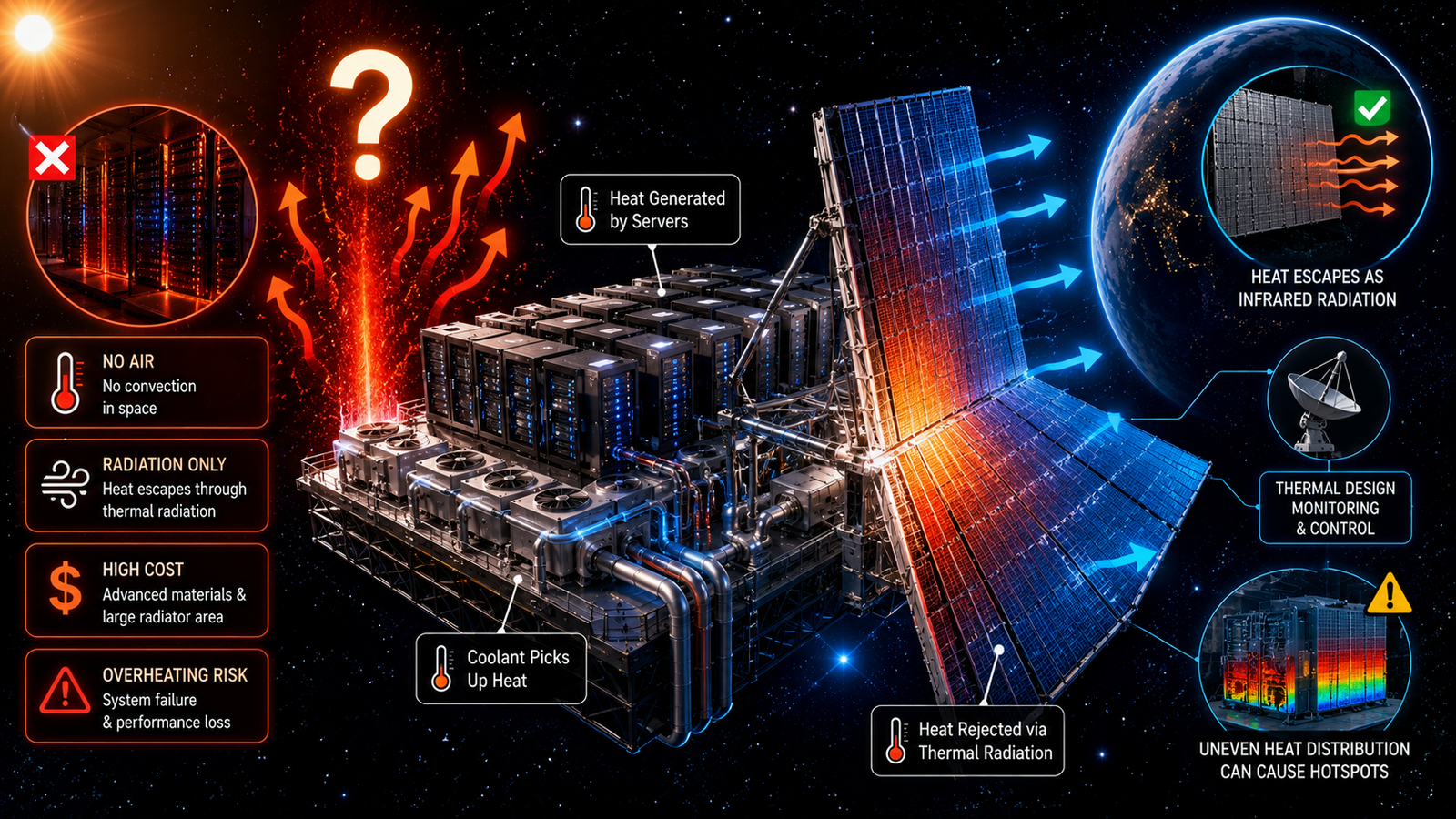
As a result, radiation becomes the only practical way for a spacecraft to get rid of excess heat into space. Internally, spacecraft can still use conduction and liquid cooling loops to move heat to radiator panels, but the final step of rejecting that heat to space happens through radiation.
So, Where Does the Heat Actually Go?
This is where many people get confused.
Heat doesn’t simply disappear into the empty vacuum.
Instead, a hot object emits infrared radiation—tiny packets of electromagnetic energy called photons.
These photons travel away from the object at the speed of light.
As they leave, the object loses thermal energy and gradually cools down.
The energy continues traveling through space until it eventually strikes something else, such as:
- A planet
- A spacecraft
- A moon
- Dust particles
- Interstellar gas
When that happens, the object absorbing the radiation gains some of that energy and warms slightly.
Because space is unimaginably vast, the radiation spreads over enormous distances and becomes extremely diffuse, making its effect negligible in most cases.
Why Do Spacecraft Need Giant Radiators?
Since there is no surrounding air to carry heat away, spacecraft need another solution.
That’s where thermal radiators come in.
These large panels aren’t there to generate electricity like solar panels.
Their job is exactly the opposite.
They provide a large surface area from which heat can be emitted into space as infrared radiation.
The more heat a spacecraft generates, the larger its radiator system generally needs to be.
This is why the International Space Station has massive white radiator panels that continuously release excess heat into space while internal coolant systems transport heat from onboard equipment to those radiators.
Could Future Space Data Centers Use This Method?
Some researchers and technology companies have proposed placing computing infrastructure in orbit to reduce environmental impacts on Earth.
In theory, space-based facilities could reject heat using large radiator panels instead of traditional air-conditioning systems.
However, that doesn’t make cooling “free.”
Radiators must still be carefully engineered, and larger computing systems would require increasingly larger heat-rejection surfaces.
Engineers also have to balance sunlight, Earth’s reflected heat, and internal power consumption, making thermal management one of the biggest challenges in spacecraft design.
Final Thoughts
At first glance, outer space seems like the perfect cooling environment because it’s incredibly cold.
But cooling doesn’t happen simply because the surroundings are cold—it depends on how heat can leave an object.
Here on Earth, heat escapes through conduction, convection, and radiation.
In space, radiation does almost all of the work.
That’s why spacecraft rely on specially designed radiator panels instead of fans or air conditioners. They slowly release heat as infrared radiation, allowing satellites, space stations, and future spacecraft to keep operating safely.
So the next time someone says, “Space is cold, so cooling must be easy,” you’ll know the answer.
The real challenge isn’t the temperature of space—it’s giving heat a way to escape.
Key Takeaways
- Heat moves through conduction, convection, and radiation.
- In the vacuum of space, convection is absent and external heat rejection occurs almost entirely through radiation.
- Spacecraft emit infrared radiation to lose heat.
- Large radiator panels help spacecraft release excess thermal energy.
- Space may be cold, but managing heat there is still a major engineering challenge.
FAQs
1. Why don't fans work in space?
Fans only circulate air. Since there is no surrounding atmosphere in space, they cannot remove heat from a spacecraft’s exterior.
2. How do spacecraft cool themselves?
Spacecraft move heat internally using conduction and coolant loops, then release it through large radiator panels that emit infrared radiation into space.
3. Does heat disappear in space?
No. Heat leaves an object as electromagnetic radiation and continues traveling through space until it is absorbed by another object.
4. If space is cold, why do satellites overheat?
Satellites constantly absorb energy from the Sun and generate heat through onboard electronics. Without proper thermal control, they can overheat because radiation is the only effective way to remove that heat.
Pingback: How 16:9 Became the Standard TV Screen Size