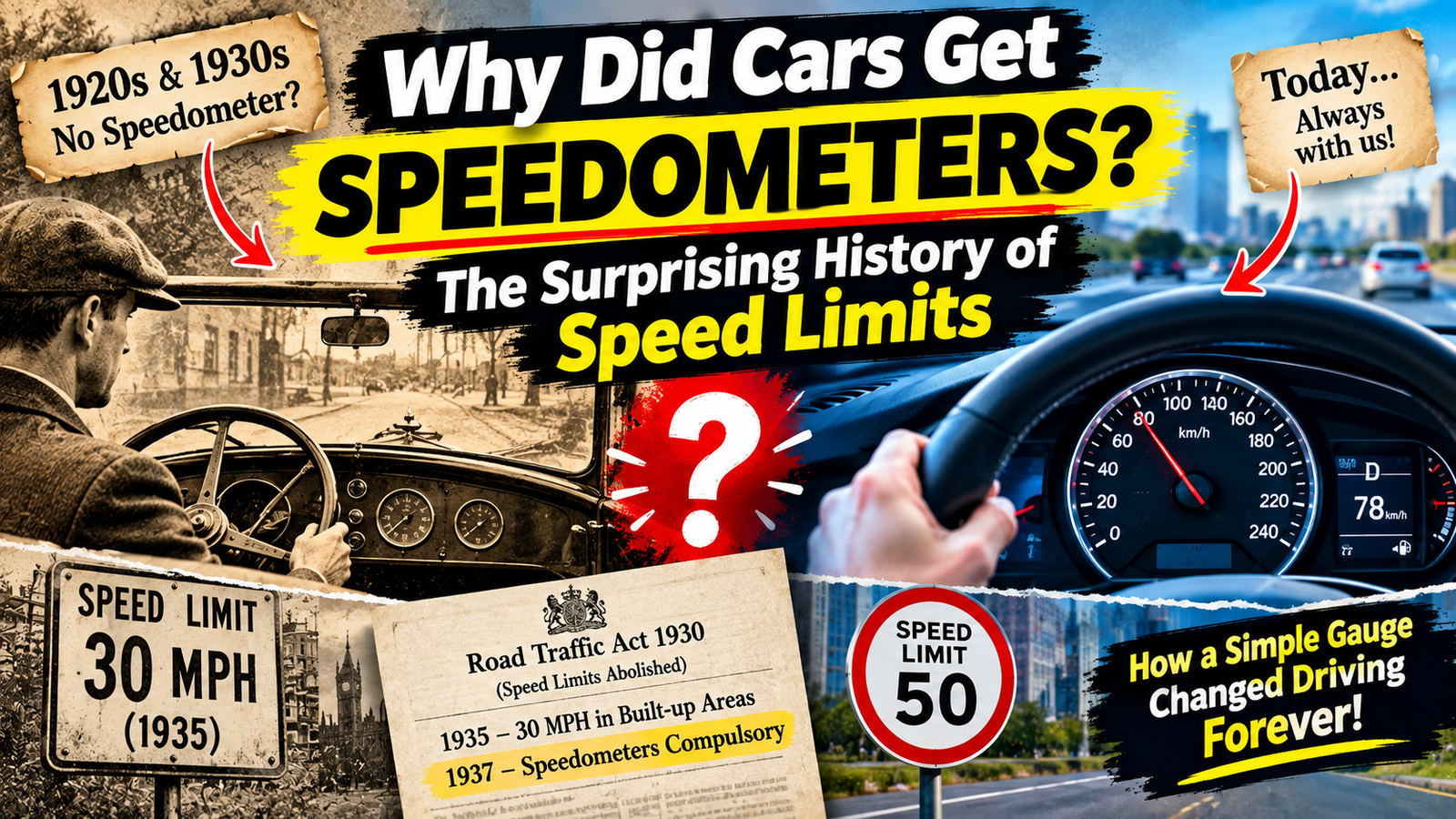
Imagine driving a car without a speedometer.
You’re moving along, the engine sounds fine, the road is clear, and you think you’re probably doing around 40 km/h.
But what if you’re actually doing 55?
Today, that sounds almost impossible. We glance at the dashboard without even thinking about it.
But early cars often didn’t give drivers such a precise way to know their speed. And as automobiles became faster and quieter, simply feeling how fast you were going became less reliable.
So why did speedometers become a standard part of cars?
The answer has a lot to do with speed limits, the law, and a surprisingly practical problem faced by drivers and governments.
Early Cars Didn't Always Have Speedometers
When automobiles first became common, speedometers weren’t necessarily standard equipment.
Cars were slower, noisier, and mechanically very different from modern vehicles. Engine vibration, road noise, and the general behavior of the vehicle could give an experienced driver some idea of how fast they were traveling.
But that changed as automotive engineering improved.
Engines became smoother. Vehicles became more powerful. Cars became capable of maintaining higher speeds without feeling dramatically different.
That created a problem.
If your car becomes quieter and smoother, how do you know whether you’re traveling at 30, 40, or 50 km/h?
Your senses aren’t a particularly accurate measuring instrument.
Speed Limits Came Before Mandatory Speedometers
Here’s the surprising part: speed limits existed before speedometers became compulsory.
Britain had already been regulating vehicle speeds for decades. But the rules changed significantly during the early 20th century.
In 1931, the general speed limits for cars and motorcycles were abolished under the Road Traffic Act 1930 because the existing limits were widely ignored and were considered ineffective.
That didn’t mean Britain gave up on speed regulation.
A 30 mph (48 km/h) limit for built-up areas was introduced in 1935. Speed restrictions also continued to apply to certain classes of vehicles, including buses and heavy vehicles.
And this created a very obvious question:
How is a driver supposed to know whether they’re breaking the speed limit if the vehicle doesn’t tell them their speed?
You may also like this article :- Smart Homes Powered by AI: How Artificial Intelligence Is Transforming Modern Living
The Government Had a Speedometer Problem
This issue was serious enough to reach Parliament.
In December 1932, Lord Buckmaster argued that vehicles subject to statutory speed restrictions should be equipped with trustworthy speedometers so drivers could know when they were exceeding the legal limit.
A proposed Road Traffic (Speedometer) Bill followed in 1933, showing that compulsory speed measurement was already being seriously considered before the final regulations arrived.
So the story wasn’t simply about car manufacturers deciding, “Let’s put another gauge on the dashboard.”
It was increasingly about making speed laws practical to follow.
Why Couldn't Drivers Just Judge Their Speed?
Because human perception isn’t very good at estimating vehicle speed.
Think about driving your own car today.
At 30 km/h, you might barely notice how quickly you’re moving. At 50 km/h, the experience can still feel surprisingly calm on a modern road.
Now imagine doing the same thing in an early automobile.
As vehicles became mechanically refined, the old clues—engine noise, vibration, and general movement—became less dependable.
A driver couldn’t simply say, “The car feels like 40 km/h, so I must be doing 40.”
A measuring instrument was much more useful.
You may also like this article :- Why Aren’t AI Data Centers Built in Antarctica?
Britain Made Speedometers Compulsory
The transition happened in the 1930s.
The UK government’s road-safety history records that speedometers and safety glass in windscreens were made compulsory in 1937.
The more precise regulations specified vehicles registered on or after 1 October 1937. The 1955 Motor Vehicles (Construction and Use) Regulations explicitly referred to vehicles registered from that date being fitted with a speed indicator.
Modern UK government inspection guidance still uses 1 October 1937 as the key date when determining whether certain vehicles are required to have a speedometer.
Why not simply install speedometers in every old car?
Because retrofitting older vehicles wasn’t always straightforward, and lawmakers had to decide how the new requirement would apply to vehicles that were already on the road.
The result was essentially a grandfathering approach: older vehicles were generally treated differently, while newly registered vehicles had to meet the requirement.
You may also like this article :- How 16:9 Became the Standard TV Screen Size
The Speedometer Became More Than a Dashboard Gadget
Today, we think of a speedometer as something that’s always been part of a car.
But historically, it solved a very specific problem.
The government wanted drivers to obey speed restrictions.
Drivers needed to know their actual speed.
And manufacturers could provide an instrument that gave them that information.
That’s a pretty logical chain.
Speed limits → need to measure speed → speedometers become increasingly important → mandatory equipment.
And This Changed How We Drive
There’s another subtle change that happened along the way.
Before speedometers became normal, drivers had to rely much more heavily on their surroundings and the behavior of the vehicle.
Today, we constantly monitor numbers.
40.
41.
42.
43.
44.
That little dial—or digital number on your dashboard—has become part of how we understand driving.
And modern cars have taken the idea even further with digital displays, cruise control, GPS-based speed information, speed-limit warnings, and intelligent driver-assistance systems.
But the basic idea hasn’t changed.
You need a reliable way to know how fast you’re moving.
You may also like this article :- Why Are Phone and Calculator Keypads Reversed?
The Next Time You Look at Your Speedometer...
It may look like one of the simplest instruments in your car.
But it represents a much bigger change in transportation.
Early cars didn’t always need a precise speed display because speed regulation, vehicle performance, and driving conditions were very different.
As cars became smoother and speed laws became more important, guessing wasn’t good enough anymore.
Governments needed enforceable rules.
Drivers needed a way to know whether they were following them.
And the humble speedometer became the answer.
So the next time you glance down and see 50 km/h, remember: that number isn’t just telling you how fast your car is moving.
It’s part of a century-old solution to a very simple question:
“How fast am I actually going?”
You may also like this article :- Why Does a Cricket Wicket Have Three Stumps?
Key Takeaways
- Early automobiles did not always have speedometers as standard equipment.
- Speed limits existed before speedometers became compulsory.
- Britain abolished general speed limits for cars and motorcycles in 1931, but introduced a 30 mph built-up-area limit in 1935.
- Parliament was discussing compulsory speedometers as early as 1932–1933.
- Speedometers became compulsory for relevant newly registered vehicles from 1 October 1937.
- The main practical reason was simple: drivers needed a reliable way to know their speed and comply with speed restrictions.
External Authority References
FAQs
1. When did cars start having speedometers?
Speedometers existed before they became mandatory, but Britain made them compulsory for relevant newly registered vehicles from 1 October 1937.
2. Why were speedometers made mandatory?
One important reason was to allow drivers to know their actual speed when speed restrictions applied. British Parliament was discussing this issue years before the requirement took effect.
3. Did speed limits exist before speedometers?
Yes. Speed restrictions existed before speedometers became compulsory. In fact, the difficulty of enforcing speed restrictions helped create the argument for reliable speed indicators.
4. When did Britain introduce the 30 mph speed limit?
A 30 mph limit for built-up areas was introduced in 1935.
5. Were all old cars required to have speedometers?
No. The regulations used a registration-date cutoff, with 1 October 1937 being an important date for the requirement. Older vehicles were generally treated differently.
6. Could early drivers tell their speed without a speedometer?
They could estimate it using experience, engine behavior, road conditions, vibration, and other cues, but these weren’t precise measurements. As vehicles became smoother and faster, relying on feel alone became less useful.
Pingback: Why Were Wristwatches Once Considered Women's Watches?
Pingback: Why Were Chandeliers a Symbol of Wealth and Royalty?