If AI Data Centers Produce So Much Heat, Why Not Build Them in Antarctica?
It’s a question that sounds almost too obvious.
AI data centers consume enormous amounts of electricity, and a significant portion of that energy is used just to keep thousands of powerful GPUs from overheating. So why not move these facilities to the coldest place on Earth—Antarctica?
At first glance, the idea seems brilliant. Natural freezing temperatures could reduce cooling costs, and the icy environment appears perfect for keeping servers cool.
But here’s the catch: cooling is only one piece of the puzzle.
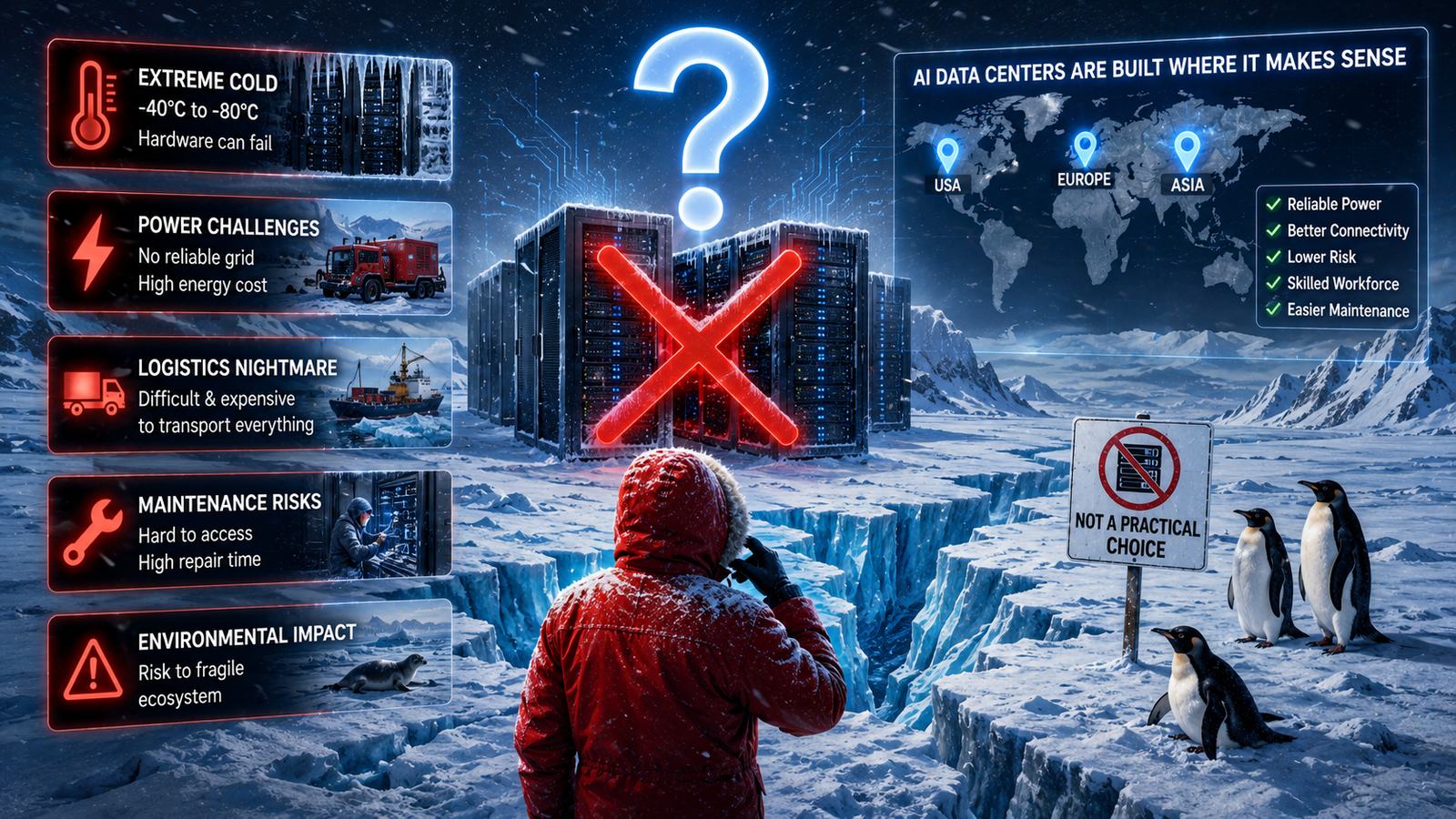
Running a modern AI data center requires much more than cold weather. It needs massive amounts of reliable electricity, ultra-fast internet, skilled workers, and the legal freedom to build large-scale infrastructure. Antarctica struggles with almost all of these requirements.
Let’s explore why.
Cooling Isn't the Biggest Challenge
When people think about AI data centers, they often focus on heat.
That’s understandable because powerful AI chips generate enormous amounts of heat.
However, cooling systems account for only part of a data center’s operating costs. The biggest requirement is a constant supply of electricity.
Even if Antarctica’s freezing air reduced cooling expenses, the servers would still need huge amounts of reliable power 24 hours a day.
Without affordable electricity, a cold climate alone doesn’t make a data center practical.
Antarctica Doesn't Have a Commercial Power Grid
Unlike countries where large data centers are typically built, Antarctica has no continent-wide commercial power network.
Most research stations generate electricity using imported diesel fuel, while some are experimenting with renewable energy to reduce fuel consumption. Delivering fuel across thousands of kilometers of ocean is expensive, difficult, and environmentally risky.
Building a massive AI data center would require far more electricity than these research stations currently use.
Creating dedicated power plants would also involve significant environmental, logistical, and regulatory challenges.
Fast Internet Matters More Than You Think
AI data centers don’t just perform calculations—they constantly exchange massive amounts of information with users, cloud platforms, and other data centers around the world.
For that, they depend on high-capacity fiber-optic internet connections.
Here’s the problem:
Antarctica is the only continent that still isn’t connected to the global internet through undersea fiber-optic cables.
Instead, most research stations rely on satellite communication, which provides much lower bandwidth and higher latency than fiber networks. Although studies are exploring the possibility of laying submarine cables to Antarctica, no operational commercial connection exists today.
For AI services that millions of people use every second, that simply isn’t good enough.
Building and Maintaining a Data Center Would Be Extremely Difficult
Even if power and internet were available, there is another major obstacle—maintenance.
Modern AI data centers require technicians to replace hardware, repair equipment, upgrade servers, and monitor operations throughout the year.
Antarctica is one of the harshest environments on Earth.
Extreme cold, powerful winds, months of darkness during winter, and limited transportation make construction and maintenance far more complicated than in conventional locations.
Something as routine as replacing a faulty server could become a major logistical operation.
The Antarctic Treaty Protects the Continent
Perhaps the biggest reason has nothing to do with technology.
It has to do with law.
Antarctica is governed by the Antarctic Treaty System, and its Environmental Protocol designates the continent as a natural reserve devoted to peace and scientific research.
Commercial industrial development is heavily restricted, and any large infrastructure project must undergo strict environmental assessment. The goal is to preserve one of Earth’s most fragile ecosystems rather than turn it into an industrial hub.
In other words, even if companies wanted to build massive AI server farms there, obtaining approval would be extremely challenging.
So Where Are Companies Building AI Data Centers Instead?
Rather than Antarctica, technology companies often choose regions that offer a balance of natural cooling and strong infrastructure.
Countries such as Iceland, Norway, Sweden, and Finland have become attractive locations because they combine cool climates with reliable renewable electricity, modern fiber-optic networks, skilled workforces, and well-developed transportation systems.
These locations provide many of Antarctica’s cooling advantages without its enormous practical limitations.
Could Antarctica Ever Host AI Data Centers?
Never say never.
If future technologies dramatically reduce infrastructure costs, clean energy becomes easier to generate locally, and international agreements evolve, Antarctica might one day support specialized computing facilities for scientific research.
However, commercial AI data centers serving millions of users worldwide remain highly unlikely in the foreseeable future.
For now, the continent’s primary role is supporting climate research, astronomy, and environmental science—not powering the world’s AI revolution.
Final Thoughts
At first glance, Antarctica seems like the perfect place for AI data centers because its freezing temperatures could help cool powerful servers.
But modern data centers need much more than cold air.
They depend on affordable electricity, high-speed fiber internet, reliable transportation, continuous maintenance, and supportive legal frameworks. Antarctica lacks most of these essentials, while strict environmental protections make large-scale commercial development difficult.
So, the next time someone asks, “Why don’t we just build AI data centers in Antarctica?”, you’ll know the answer.
The challenge isn’t keeping the servers cold—it’s building an entire digital ecosystem in one of the most remote and protected places on Earth.
Key Takeaways
- Cold weather alone isn’t enough to make Antarctica suitable for AI data centers.
- Reliable electricity is a much bigger requirement than cooling.
- Antarctica has no commercial power grid and currently relies mainly on imported fuel for research stations.
- The continent still lacks a commercial undersea fiber-optic connection to the global internet.
- The Antarctic Treaty System prioritizes environmental protection and scientific research over commercial industrial development.
- Countries like Iceland and Norway offer a better balance of cool climates, renewable energy, and modern infrastructure.
FAQs
1. Why do AI data centers generate so much heat?
AI servers use thousands of high-performance GPUs that consume large amounts of electricity. Much of that electrical energy is converted into heat, making advanced cooling systems essential.
2. Would Antarctica reduce data center cooling costs?
Yes, the cold climate could reduce cooling requirements. However, cooling is only one part of operating a data center. Reliable electricity, internet connectivity, and infrastructure are much more important.
3. Does Antarctica have fiber-optic internet?
No. Antarctica is currently the only continent without an operational undersea fiber-optic connection and mainly depends on satellite communications for internet access.
4. Why can't companies simply build power plants there?
Large commercial energy projects face significant logistical, environmental, and legal challenges. The Antarctic Treaty System also places strict protections on the continent to preserve its natural environment.
Pingback: Why Are Phone and Calculator Keypads Reversed?
Pingback: Why Does a Cricket Wicket Have Three Stumps?
Pingback: Why Did Cars Get Speedometers? The History of Speed Limits