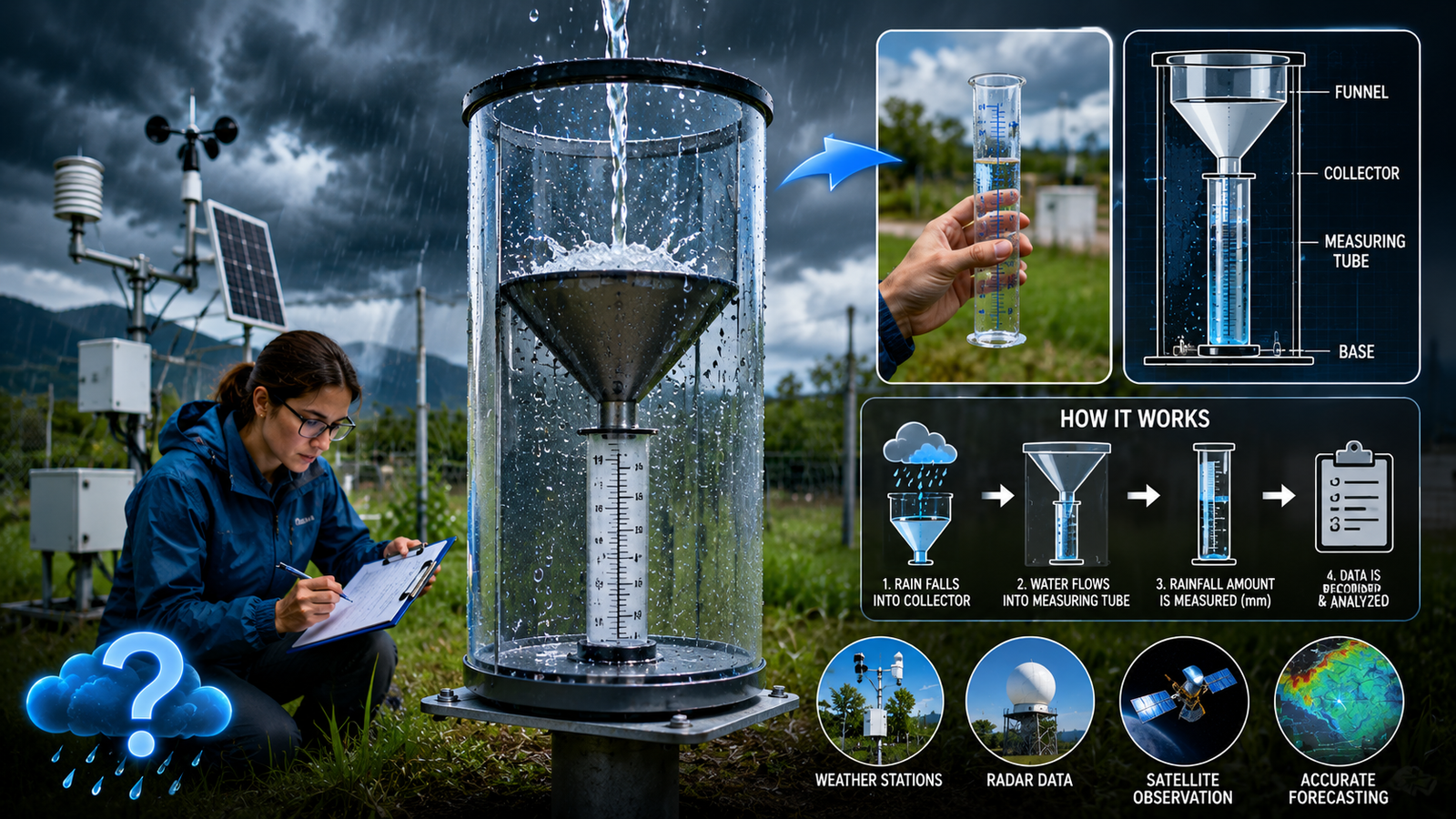
Have You Ever Wondered What "50 mm of Rain" Really Means?
Every monsoon season, weather reports mention numbers like 20 mm, 75 mm, or even 150 mm of rainfall. But what do these numbers actually represent?
Many people assume they describe how “hard” it rained or how much water filled the roads. In reality, rainfall is measured in a much more scientific way.
The interesting part is that meteorologists don’t measure rain by simply placing a bucket outside. Instead, they use carefully designed instruments called rain gauges, which follow a standard method used around the world.
Let’s break it down in simple language.
What Does 1 mm of Rainfall Mean?
Imagine you have a perfectly flat surface measuring 1 square meter.
Now suppose it rains, and the water collects on that surface without soaking into the ground, evaporating, or flowing away.
If the collected water forms a layer that is 1 millimeter deep, that is called 1 mm of rainfall.
Another easy way to understand this is through volume.
Since a one-square-meter area covered by water that is 1 millimeter deep contains 1 liter of water, meteorologists say:
- 1 mm rainfall = 1 liter of water per square meter
- 10 mm rainfall = 10 liters per square meter
- 50 mm rainfall = 50 liters per square meter
This standard definition allows rainfall to be compared accurately, no matter where it is measured.
How Do Rain Gauges Measure Rain?
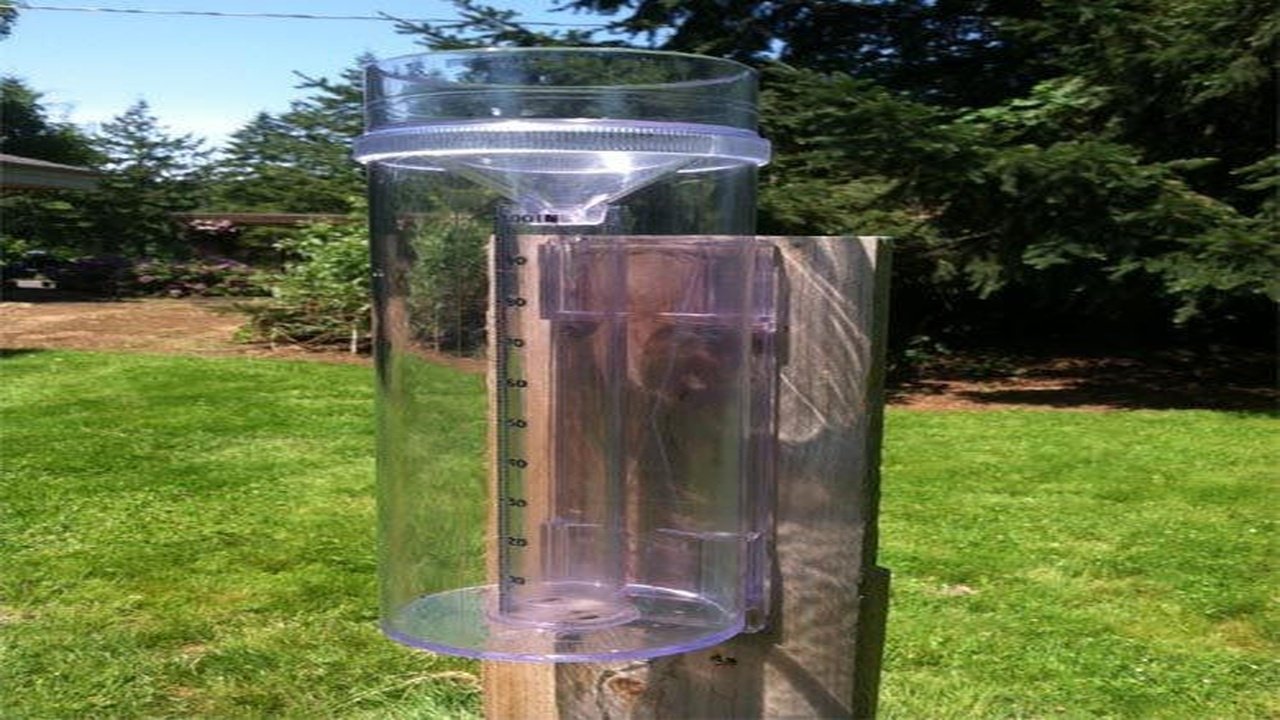
If you’ve seen a rain gauge before, you might have noticed something surprising—it doesn’t have a huge one-square-meter opening.
Instead, it uses a specially designed funnel that directs rainwater into a collection bottle.
The funnel captures rainfall over a known surface area, while the bottle stores the collected water. Later, the water is poured into a calibrated measuring cylinder that converts the collected volume directly into millimeters of rainfall.
Because the opening area of the funnel is already known, scientists don’t need a giant one-square-meter collector. They simply scale the measurements mathematically to calculate the equivalent rainfall depth.
Why Doesn't Every Rain Gauge Have the Same Size?
This is one of the biggest misconceptions.
Many people think rain gauges must all be identical.
They don’t.
Rain gauges can have different funnel sizes, but every gauge is carefully calibrated according to its collection area.
For example, the India Meteorological Department (IMD) commonly uses rain gauges with collector openings of 100 cm² or 200 cm². Since the opening area is known, the measuring cylinder is specially marked so the collected water can be read directly in millimeters of rainfall instead of milliliters.
How Is Daily Rainfall Recorded in India?
Rainfall isn’t measured continuously by someone standing beside a rain gauge.
In India’s manual observation network, rainwater is generally collected over a 24-hour period ending at 8:30 AM Indian Standard Time (IST). After that, the collected water is measured and reported as the official rainfall for the previous day.
This standardized timing ensures that rainfall observations from different locations can be compared consistently across the country.
Why Is Rainfall Measured in Millimeters Instead of Liters?
At first glance, measuring rain in liters sounds simpler.
However, the amount of water collected depends on the size of the container.
A large bucket collects more water than a small cup, even though both experience the same rainfall.
That’s why meteorologists measure the depth of rainfall instead of the total volume.
Whether rain falls on a rooftop, a football field, or a small rain gauge, 10 mm of rainfall always means the water would form a layer 10 millimeters deep if it stayed where it fell.
This makes rainfall measurements consistent and meaningful everywhere.
Why Accurate Rainfall Measurement Matters
Rainfall data is far more important than most people realize.
Governments, farmers, engineers, and weather scientists rely on accurate measurements to make important decisions every day.
Rainfall measurements help with:
- Flood forecasting and disaster management.
- Agriculture and irrigation planning.
- Reservoir and dam operations.
- Water resource management.
- Weather forecasting and climate research.
Without standardized rainfall measurements, predicting floods, droughts, or seasonal rainfall would be much more difficult.
Final Thoughts
The next time you hear a weather report saying “50 mm of rain is expected today,” you’ll know exactly what it means.
It doesn’t refer to the height of puddles or how deep the water is on the road. Instead, it means that if the rainwater remained on a flat surface without draining away, it would form a layer 50 millimeters deep, or 50 liters of water over every square meter.
Behind that simple number is a carefully designed rain gauge, standardized measurement techniques, and decades of meteorological science.
So while the forecast may only mention a number, that number tells an important story about how much water has actually fallen from the sky.
Key Takeaways
- Rainfall is measured as the depth of water collected on a flat surface.
- 1 mm of rainfall equals 1 liter of water per square meter.
- Rain gauges use calibrated funnels and measuring cylinders to calculate rainfall accurately.
- Different rain gauges can have different opening sizes, but all are calibrated to produce standardized measurements.
- In India, manual rainfall observations are commonly recorded over a 24-hour period ending at 8:30 AM IST.
FAQs
1. What does 1 mm of rainfall mean?
It means enough rain has fallen to create a water layer 1 millimeter deep on a flat surface where no water is absorbed, evaporates, or runs off. It is also equal to 1 liter of water per square meter.
2. How does a rain gauge work?
A rain gauge collects rainwater through a funnel and stores it in a container. The collected water is then measured using a calibrated cylinder that converts the volume into millimeters of rainfall.
3. Why is rainfall measured in millimeters?
Millimeters measure the depth of accumulated water, making rainfall measurements consistent regardless of the size of the collection container.
4. When is rainfall measured in India?
Manual rainfall observations are generally recorded over a 24-hour period ending at 8:30 AM IST, following the standard practice used by the India Meteorological Department.
Pingback: Why Does a Cricket Wicket Have Three Stumps?